
Springfield Township City Directory Shelf
Springfield Township is an unincorporated township, not an incorporated city with its own city-clerk directory. The historical shelf is instead a Hamilton County and library trail. CHPL’s Digital Library makes City & County Directories available to browse, search, and download, while CHPL holdings and the Cincinnati History Library & Archives supply access beyond the digitized runs. The Hamilton County Genealogical Society directory guide adds coverage notes and access guidance.
| Collection | Years | Where Held | Access |
|---|---|---|---|
| Cincinnati volumes | 1819–1949 selected runs | CHPL Digital Library; later selected runs at CHPL and other databases | Digital browse, search, download, or library research |
| Hamilton County Directories | 1887, 1889, 1891, 1893, 1897, 1899, 1901, 1905, 1907/08, 1909/10, 1911/12 | CHPL Digital Library | Online name or address search, browse, and download |
| Hamilton County 1915 and 1939/40 | 1915; 1939/40 outside-Cincinnati list | Cincinnati History Library & Archives; CHPL collection | 1915 is held but not online; 1939/40 is a county-outside-Cincinnati run |
| Pink Pages / Criss-Cross | Pink Pages from 1925; Criss-Cross by 1941 | CHPL house-history resources | Address-first historical lookup |
The Cincinnati series has no published 1852 or 1854 volume. A missing year is a publication gap, not evidence that a household was absent. The city directory collection is historical evidence, so the edition year and the locality heading should travel with every note.
Springfield Township City Directory Years
Cincinnati volumes begin with 1819, then include selected early editions and a broad 1849/50–1945 and 1947–49 run. A Township household may appear in a Cincinnati-oriented volume when its postal, community, or street context overlaps that market, but the printed place label still needs checking. Treat an edition as a time-stamped listing, not a modern jurisdiction statement.
Browse the CHPL city and county directory collection to locate an available year.
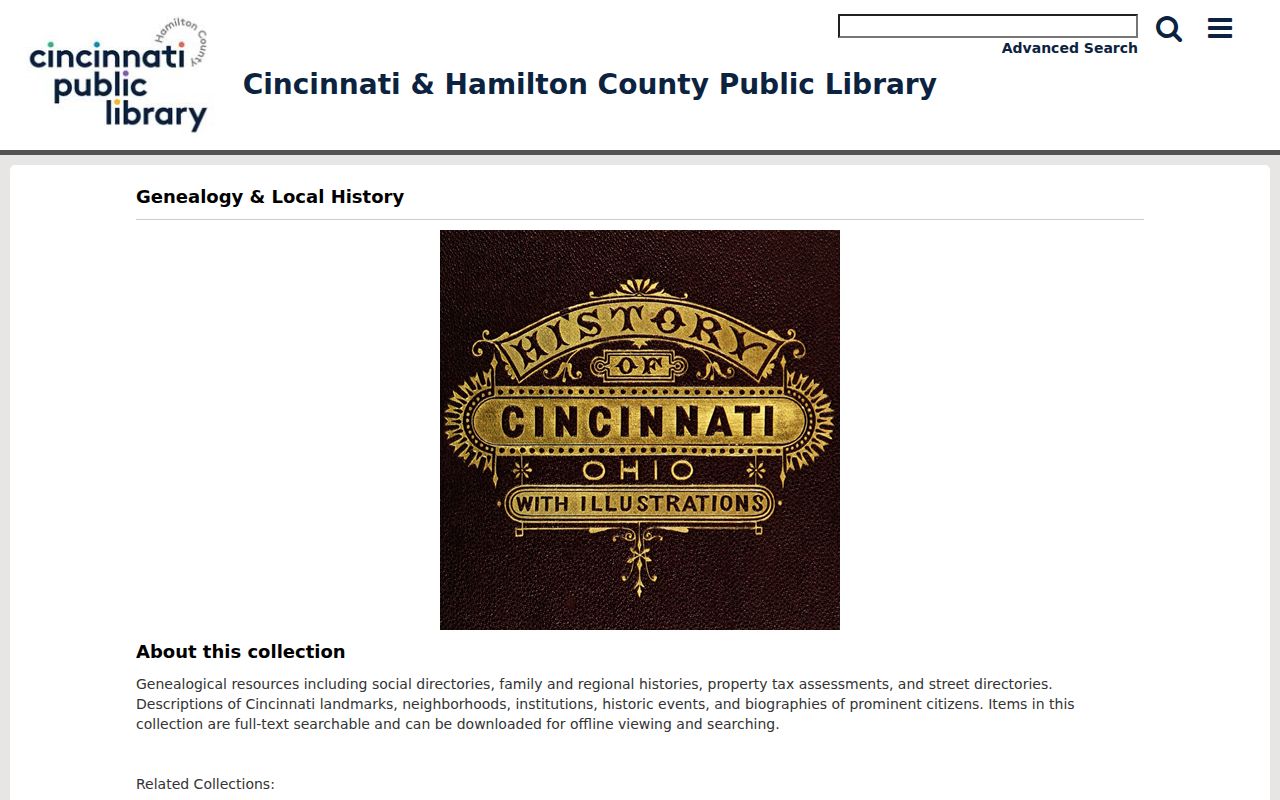
The digital collection is the online starting point, while the library route matters when an edition is held but not digitized.
Springfield Township Directory Labels
The Hamilton County volumes are especially important for Springfield Township because early directories used separate town and village lists. Search both a name and address before deciding a result is missing. A household may be filed under New Burlington, Woodlawn, Glendale, Mount Healthy, or a rural route instead of a modern Township or Cincinnati label. One digitized volume notes that Transit is the post-office address of New Burlington, a small but decisive locality quirk.
HCGS documents that many pre-1942 directories can be searched by name or address, browsed online, or downloaded.
Use the HCGS directory-years guide to compare the available county runs.
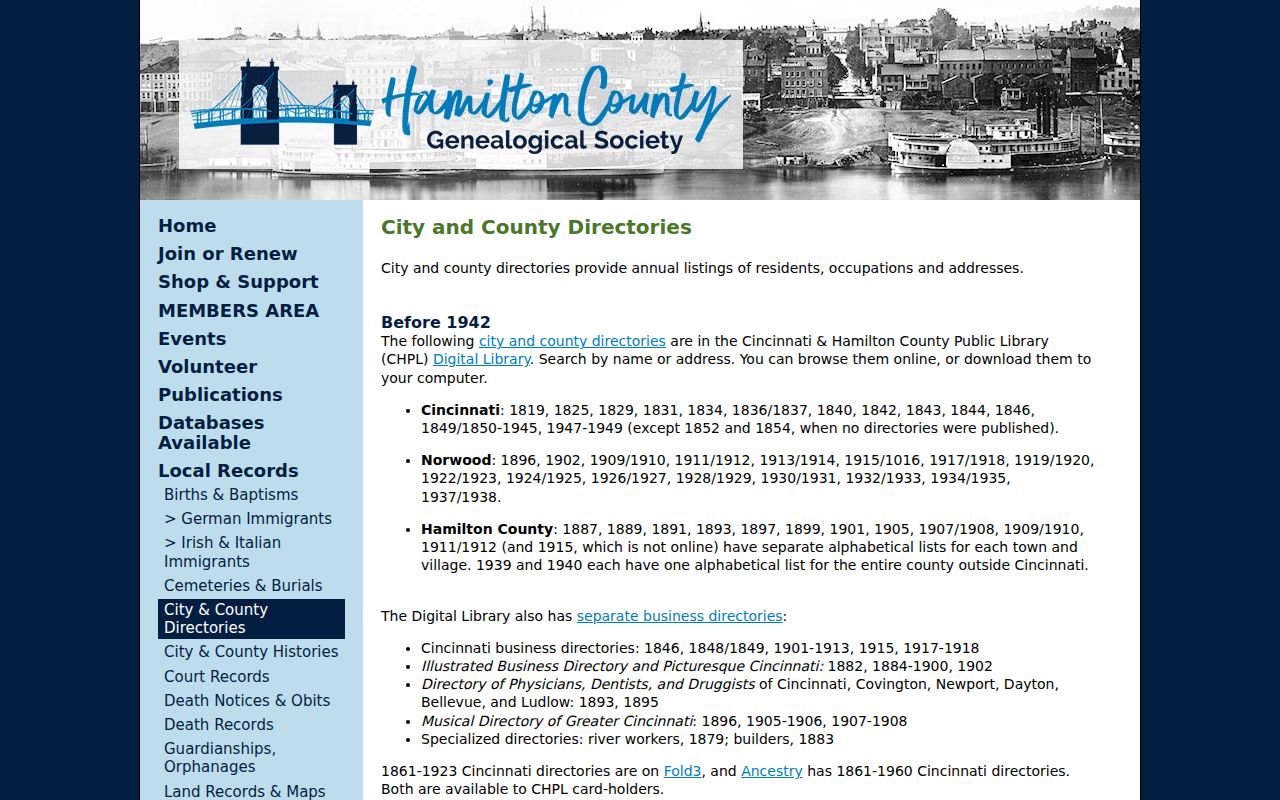
The coverage guide helps distinguish an unavailable year from a locality or spelling problem in the city directories.
Springfield Township Directory Research Desks
CHPL Genealogy & Local History holds the printed volumes alongside census records, newspapers, naturalization papers, maps, church and cemetery records, plus staff reference help and research access. The HCGS local-records gateway supplies a different channel for historic Recorder materials, damaged deeds, land maps, court and probate records, obituaries, cemetery material, school records, and research services. Some HCGS material has member or purchase conditions.
For image-led research, the Recorder links to Ohio, Hamilton County Records, 1791–1994, a collection of 1,566,282 images. It includes land, probate, vital, naturalization, marriage, and cemetery-lot material. A free account may be required, and the collection is an image research route rather than a directory replacement.
Note: A name in a library or society index is a historical lead that should be checked against the original image, edition, or custodian record.
Reading Springfield Township Directory Entries
A name-oriented directory entry commonly gives the person’s name, occupation, and address. CHPL’s house-history guidance adds that an entry can identify a spouse and may contain an owner or occupancy cue. The exact arrangement varies by edition. A digitized Hamilton County page visibly uses person names, occupations, and local-community headings, while the publisher imprint helps identify the edition. Record what is actually printed rather than carrying a symbol or abbreviation from one volume into another.
| Name | The listed person, with spelling as printed in that edition. |
|---|---|
| Address | Street and number, or a local-community and postal heading. |
| Occupation | Published work description when the volume supplies one. |
| Spouse or role cue | A spouse or printed ownership/occupancy indication when that edition carries it. |
| Edition context | Year, locality heading, page, and publisher imprint needed to repeat the finding. |
- Criss-Cross directory
- An address-ordered directory that puts streets in alphabetical order and numbers in sequence.
- Householder index
- A name-oriented listing used to locate a person or household before comparing address entries.
- Abbreviation key
- The edition’s own front-matter legend. No complete local key was captured for every volume, so inspect it instead of guessing.
Note: A printed address shows the directory’s dated listing and should not be treated as a current residence claim.
Springfield Township City Directory Addresses
Pink Pages are the address-first part of the historical address-volume route. They started in 1925, and the series was known as Criss-Cross by 1941. Read the street alphabetically and the numbers in order to find the published occupant associated with a past address. That approach differs from an Auditor parcel record: the directory follows historical publishing practice, while the parcel card identifies a deeded owner of record.
The comparison is useful when a historic household and a present property owner are not the same person. Preserve the volume year, street form, number, and page so the result can be checked against deeds, maps, or a later edition. For present-day property details, use the Springfield Township Street Directory record chain.
Springfield Township Directory Timeline
Directory research depends on choosing the record set that matches the time period. The sequence below marks the local collection’s key transitions and explains why an address trail may need more than one shelf.
- 1819: Cincinnati city-directory volumes begin.
- 1887–1915: Selected Hamilton County town and village directory runs cover the Township era, with the 1915 volume held but not online.
- 1925: Pink Pages provide an address-first path.
- 1941: Pink Pages are called Criss-Cross.
- 1939/40: A county-outside-Cincinnati directory run offers another route for Township communities.
Hamilton County courthouse fires in 1813, 1849, and 1884 also explain why a directory hit can need support from restored probate series, damaged-record indexes, cemeteries, church records, or newspapers. A silent early index is not proof that the historical event never occurred.
Springfield Township Cemetery Context
When a directory trail ends, cemetery material can help test a date, family connection, or place association without turning a burial record into a current-address claim. HCGS has a 22-volume burial series, including Springfield Township Cemeteries as Volume 7. Its index identifies local burial grounds such as Beech Grove and the inactive Mount Pleasant/Seward cemetery. The records are a historical companion to the annual volumes, Probate material, and newspaper research.
HCGS cemetery resources also point researchers toward its wider cemetery-index coverage. Compare a burial or death notice with the edition date, original cemetery evidence, and any Probate or Recorder record. The useful conclusion is a dated family-history lead, not an assumption about a person’s address at any later time.
Trace Springfield Township City Households
Use consecutive annual volumes to build a dated household trail, not one isolated hit. Start from the most reliable name or address form, then work in both directions through the nearest available editions. The Auditor and Recorder can anchor property history, but a directory occupant and a deeded owner may be different people. Census and map sources add a household or address snapshot for a known period, while a probate, cemetery, or newspaper record can test an endpoint.
- Find the nearest available directory volume by the person’s name and test locality aliases such as New Burlington or Transit.
- Copy the address, spelling, occupation, spouse or role cue, edition year, and page.
- Read adjacent available years. A disappearance can reflect a move, death, name change, rural-route label, or a coverage gap.
- For an address start, check the Pink Pages or Criss-Cross sequence, then compare name-oriented entries.
- Pair the entry with the public federal census for 1950 or earlier and relevant historic maps. The census gives a dated household snapshot; the directory supplies annual address context.
- Test a possible endpoint through CHPL, HCGS, Probate archive, a state historical source, or FamilySearch, then record the original source and date.
Do not project a directory result forward to identify a modern household. Keep the edition, page, and source role with the finding so later evidence can confirm or revise it.
Springfield Township Directory Evidence
CHPL’s house-history route combines directories, Pink Pages or Criss-Cross volumes, Sanborn maps, newspapers, and the Local History Index with Auditor and Recorder research. The first local Sanborn maps are listed for 1891; maps from 1904 add newer addresses and color-coded building detail. Most Cincinnati addresses changed in 1895, but that city event must not be assumed for every Township address. Confirm the map coverage and historical locality before matching an old number to a current parcel.
Open the HCGS local-records gateway when a directory entry needs deed, map, court, probate, or cemetery context.
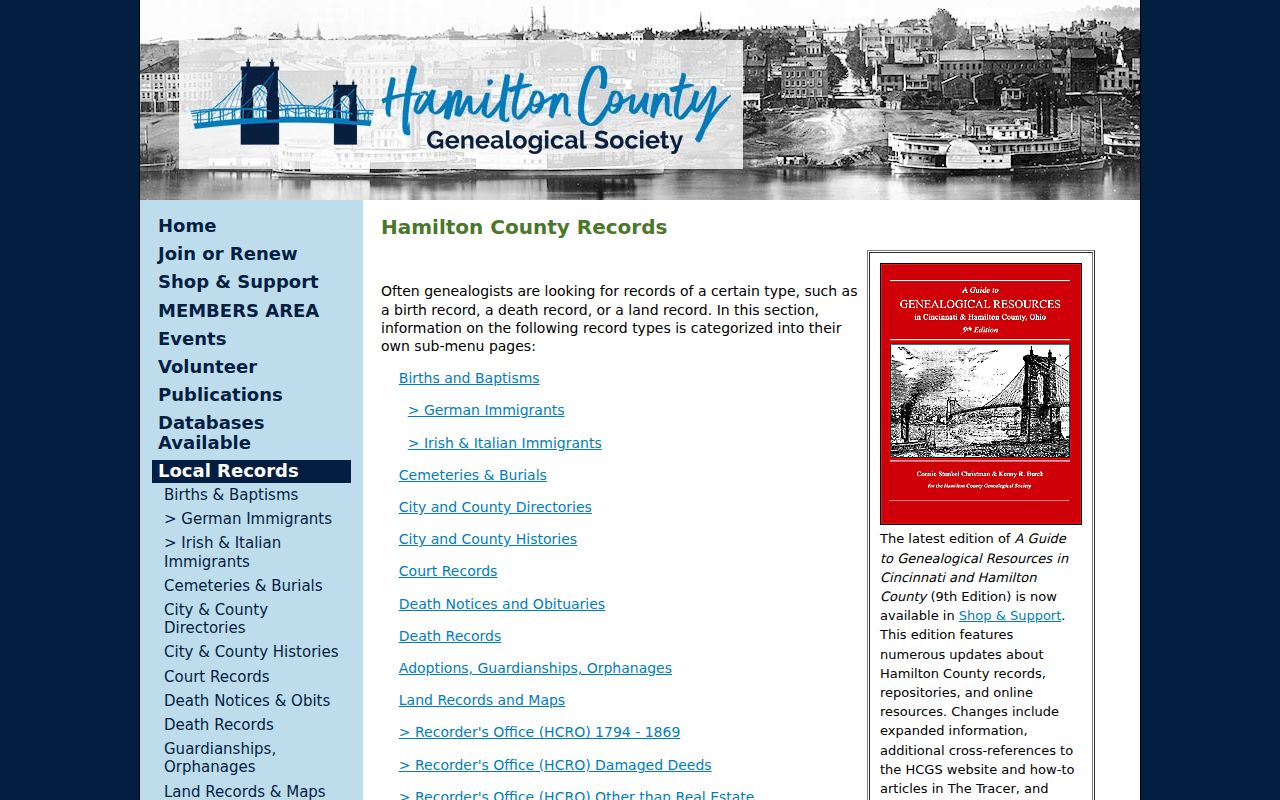
The gateway supplies companion record paths that can confirm the person, location, and date attached to a directory entry.
HCGS also maintains indexes for damaged and mutilated court records, death notices, cemetery-lot documents, school extracts, and other historical materials.
Consult the HCGS databases page for those specialty index categories.
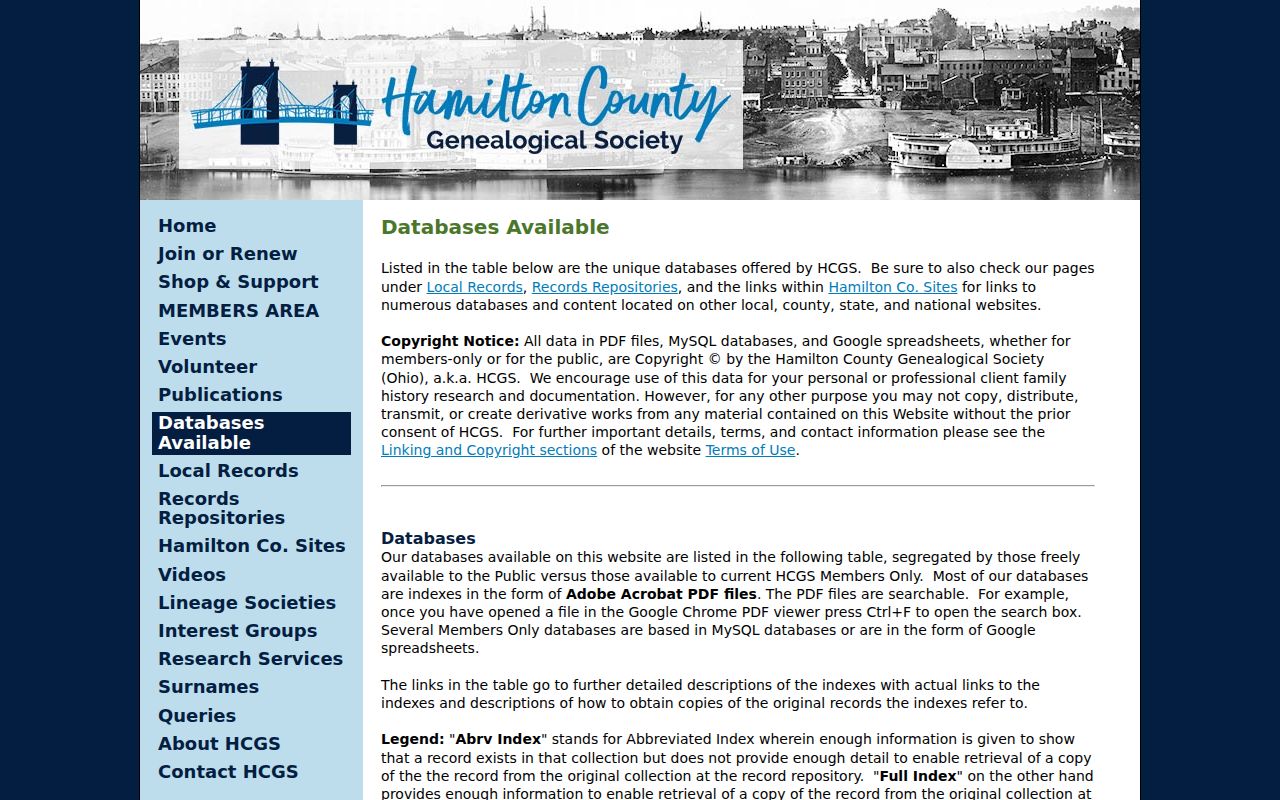
Specialty indexes can extend a historical directory trail, but the original record or image remains the best check on an index result.